
We are pleased to announce the latest study published by an international team of scientists, including our colleagues Clément François (LPL-CNRS), Ana Zappa (University of Barcelona, former LPL PhD student and postdoc), and Antoni Rodriguez-Fornells (University of Barcelona, former Iméra resident 2024/25):
Reference: Zappa, A., León-Cabrera, P., Ramos-Escobar, N., Laine, M., Rodriguez-Fornells, A., & François, C. (2025). Alpha and beta desynchronization during consolidation of newly learned words. Neuroimage. 318, 121410
Full-text article : https://hal.science/hal-04933892
Publisher’s website : https://doi.org/10.1016/j.neuroimage.2025.121410
Abstract:
The aim of this study is to better understand what happens in our brains between the moment we encounter a new word and the moment we have incorporated it into our vocabulary. To this end, we analyzed the brain activity of 19 adult participants who learned 120 new words associated with unfamiliar objects over 5 consecutive days (Figure 1).
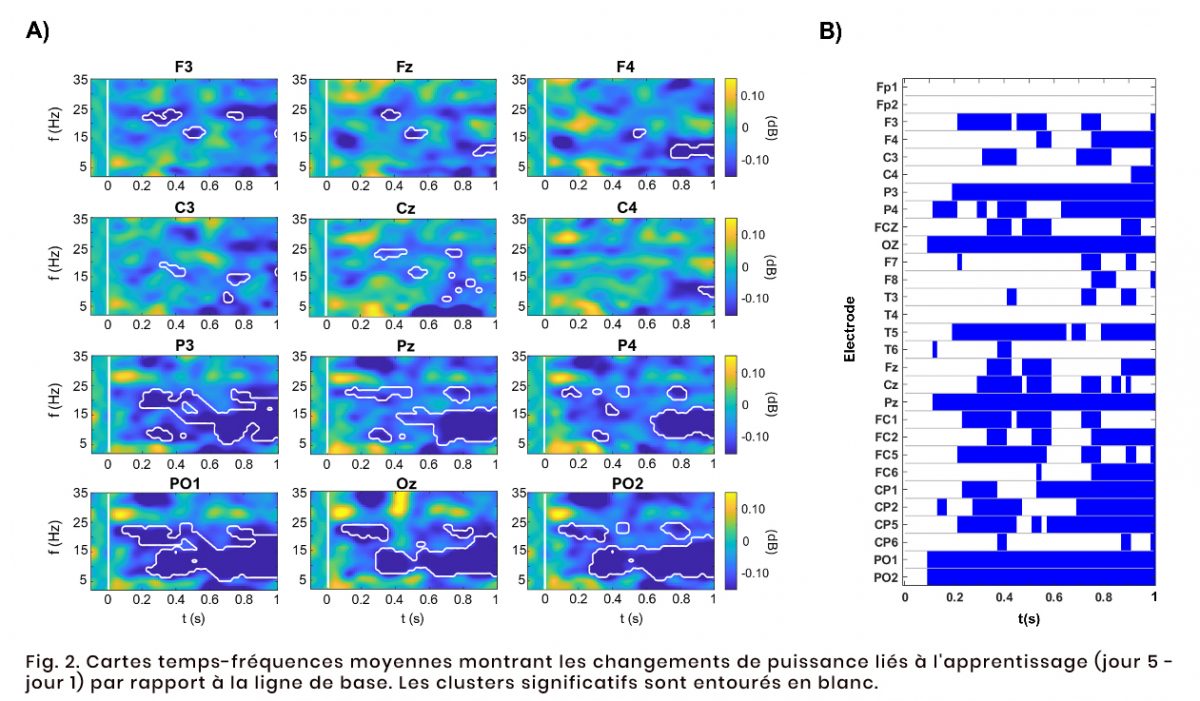
Analysis of EEG activity recorded during a silent naming task indicates greater desynchronization of alpha (8–12 Hz) and beta (13–25 Hz) waves on the fifth day compared to the first day at parietal and occipital electrodes between 200 and 1000 ms after image presentation (Figure 2).
This alpha-beta desynchronization appears to reflect the lexical retrieval of newly learned words that have been integrated following consolidation. This study thus reveals that learning new words leaves measurable signatures in our brain’s electrical activity, paving the way for a better understanding of the fundamental mechanisms of vocabulary acquisition. These findings could have implications for foreign language teaching and the understanding of language learning disorders.